16 posts tagged with "Trace-Based Testing"

View All Tags

Unit vs Component Tests in Spring: Where the Boundary Lies and Why You Need Both

· 10 min read
Evgenii Frolikov
Senior Java Architect | Expert in High-Load Systems & JVM Internals

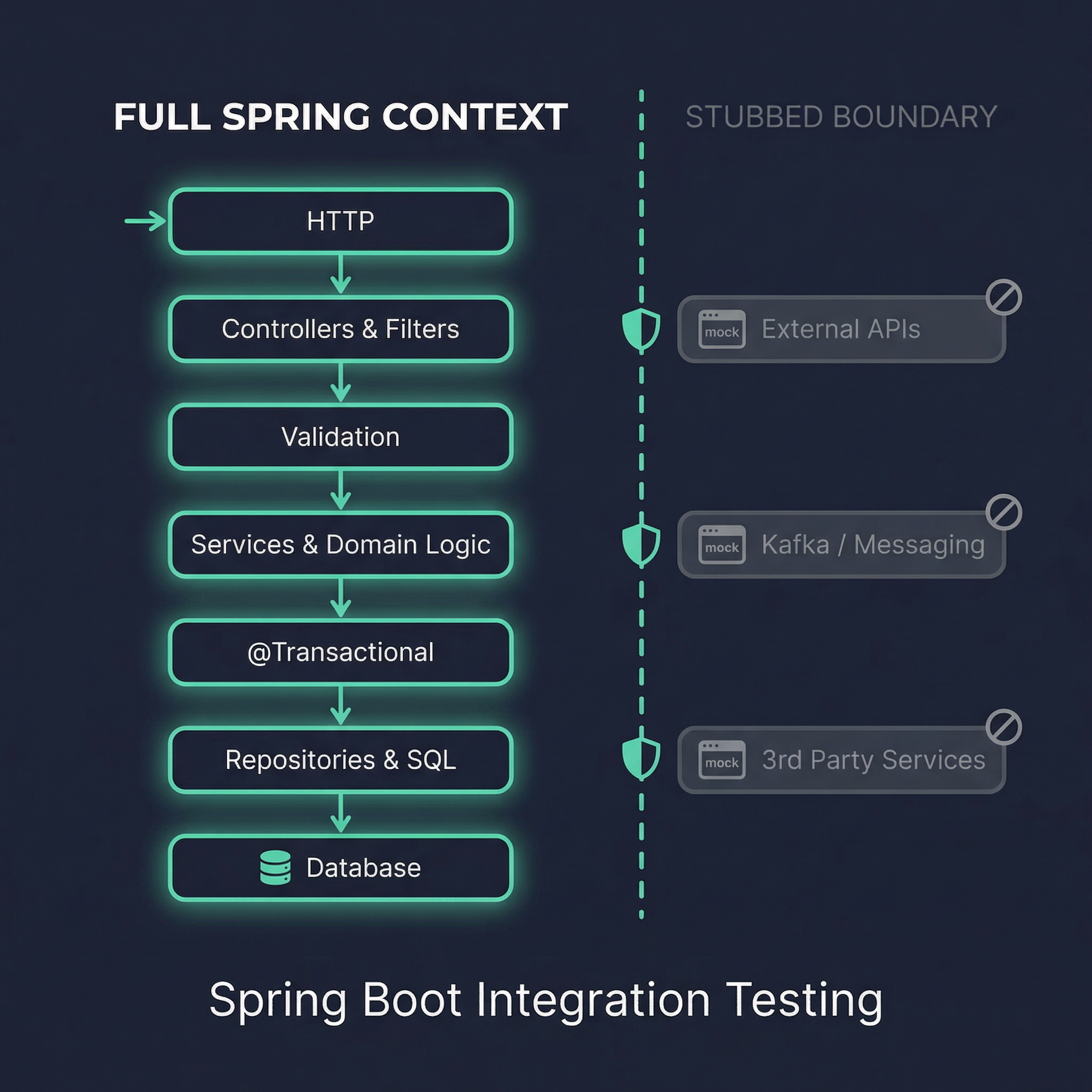
TL;DR: In real-world Spring projects, the "unit vs integration" debate almost always stems from the fact that "integration testing" has become a catch-all term for everything from @SpringBootTest with Testcontainers to full-blown E2E runs on staging environments. To stop arguing and start shipping, we need to draw a clear line in the sand regarding responsibility.

A unit test answers one question: "Is the logic correct in total isolation?" It deliberately cuts infrastructure out of the equation.

A component test answers another: "Does the component work as a system within its own boundaries, including its Spring wiring, configurations, serialization, transactions, and data access?"

If you only have units, you'll inevitably get burned at the seams. If you only have component tests, you'll pay with execution time, flakiness, and painful debugging. The winning strategy is simple: unit tests provide the speed and density of logic verification; component tests provide the confidence that the "real assembly" actually works.

Automated Verification in the AI Era: Why Trace-Based Testing is the New Standard

· 6 min read
Dmitry Turmyshev
Product Manager | Developer Experience and Software Quality

AI Runtime Intelligence - Visualizing the safety layer for AI-native Java development

TL;DR: As AI models like Claude, GPT-4, and Gemini write more of our code, the bottleneck has shifted from writing to verifying. Traditional mock-heavy tests are too fragile for AI-native workflows. BitDive provides the Real Runtime Data needed to turn actual execution states into deterministic JUnit tests, enabling a safe and autonomous development loop.

The Verification Gap in AI-Native Development

In 2026, the industry has reached a tipping point. AI assistants can now create 1,000 lines of functional code in seconds. However, verifying that this code doesn't break subtle production invariants remains a manual, slow process.

We call this the Verification Gap.

One-Click Postman Collections from BitDive Unit and Component Tests

· 5 min read
Dmitry Turmyshev
Product Manager | Developer Experience and Software Quality

BitDive Postman Integration - Automatically creating Postman collections from Java execution traces

We’re excited to introduce a major upgrade to the BitDive ecosystem: native Postman support.

You can now create a Postman Collection from your BitDive-generated JUnit replay tests with a single click. Postman export is an additional execution format alongside the BitDive runner, derived from the same Real Runtime Data replay artifacts, so you can rerun and share endpoint requests without changing your regression suite.

BitDive automatically creates Unit and Component tests from recorded behavior, and it can now also export the tested application’s endpoint requests as Postman collections. This lets you invoke endpoints quickly, capture new executions back into BitDive, validate Consumer-Driven Contracts against real scenarios, and compare “before” vs “after” behavior with diffs after a fix.

QA in AI Assisted Development: Safety through Deterministic Verification

· 15 min read
Dmitry Turmyshev
Product Manager | Developer Experience and Software Quality

To solve the Verification Crisis, teams must move from manual mocking to Runtime Context Sharing. By integrating BitDive via Model Context Protocol (MCP), AI agents gain access to real execution traces, allowing them to propose surgical fixes and self-verify their work against Real Runtime Data. This is more than just automation; it is the Deterministic Verification Layer required for the AI-native developer.


"We're now cooperating with AIs and usually they are doing the creation and we as humans are doing the verification. It is in our interest to make this loop go as fast as possible. So, we're getting a lot of work done."

. Andrej Karpathy: Software Is Changing (Again)

AI Assisted Verification Loop - Diagram showing the cycle of AI code creation and deterministic human verification

This quote describes a shift that is already visible in many teams. Code creation has accelerated. Verification and validation increasingly become the bottleneck.

With AI tools, writing code is often not the limiting factor anymore. The hard part is proving that what was generated is correct, safe, and maintainable.

Trace-Based Java Testing: Deterministic Verification without Mocks

· 8 min read
Dmitry Turmyshev
Product Manager | Developer Experience and Software Quality

BitDive Unit Test Creation UI - Generating deterministic JUnit tests from real Java application behavior

Real Runtime Data is the Ultimate Source of Truth. Writing unit tests manually is a losing battle against technical debt. BitDive captures the actual execution of your code and transforms it into Deterministic Verification suites, eliminating the need for manual mocking and giving you the Real Runtime Data required for AI-native development.


Test to Code Ratio: Why 50%+ Test Code is the New Standard in 2026

· 8 min read
Evgenii Frolikov
Senior Java Architect | Expert in High-Load Systems & JVM Internals

Test to Code Ratio Evolution - Why 50% test density is the new standard for software quality in 2026

In the era of AI-accelerated delivery, the old 1:1 test-to-code ratio is a relic. To survive 2026, teams need 50%+ test density to handle the explosion of generated features. BitDive enables this density without the 3x maintenance cost, turning runtime behavior into a strategic Trace-Based quality moat.


Eliminate Mocks: How Trace-Based Testing Revolutionizes Enterprise Quality

· 5 min read
Dmitry Turmyshev
Product Manager | Developer Experience and Software Quality

From Fragmented Traces to Confident Releases. BitDive eliminates "Mocking Hell" by turning real-world JVM traffic into Trace-Based Testing suites. By replacing handwritten test code with recorded Replay Plans, enterprise teams reduce test maintenance by 60% and establish the Real Runtime Data needed for AI-assisted development.


BitDive Full Cycle Testing - Transforming JVM traffic into automated regression suites

Testing for JVM applications, Java, Kotlin, Spring Boot, often struggles to keep up with distributed systems, asynchronous flows, and frequent code changes. Traditional methods rely on mocks and black‑box checks that don't reflect how the system really behaves. The result: flaky tests, missed bugs, and uncertainty before release.

BitDive provides a single platform for the entire testing lifecycle. It captures real execution data, curates meaningful scenarios, replays them across builds, and validates results where it matters most, at the level of API responses, database queries, and messaging flows.

JVM-first • Testcontainers-ready • Kafka/gRPC/JDBC support • CI/CD friendly • Flake-resistant

The ROI of Trace-Based Verification

MetricTraditional Testing (Mocks)BitDive (Trace-Based)Enterprise Impact
Test Creation Time2-4 Hours / Scenario2-3 Minutes / Scenario98% Speedup
Maintenance BurdenHigh (Breaks on Refactor)Low (Behavioral Matching)60% Cost Reduction
Code Bloat+1000s lines of mocks0 (JSON-based plans)Zero Technical Debt
Data RealismHandcrafted FixturesReal Production Traffic100% Reliability

BitDive SaaS Is Live - Try It Free Today

· 3 min read
Dmitry Turmyshev
Product Manager | Developer Experience and Software Quality

Instant Runtime Observability. Stop setting up infrastructure and start verifying behavior. BitDive SaaS is the fastest entry point for teams moving to Trace-Based Testing and automated unit test creation in the cloud.


BitDive SaaS Is Live

We're excited to announce the launch of BitDive SaaS - our fully hosted, cloud-based observability platform built for modern Java microservices. This launch marks a major milestone in making deep performance tracing and real-time insight available to everyone, instantly and effortlessly.

Now, instead of setting up infrastructure or maintaining backend components, developers can get started in just minutes. The BitDive agent connects your application to our platform, and you're immediately able to trace distributed requests, profile methods, visualize service dependencies, and capture Real Runtime Data - all in a single place.

BitDive MCP Server brings full runtime context to development

· 5 min read
Dmitry Turmyshev
Product Manager | Developer Experience and Software Quality

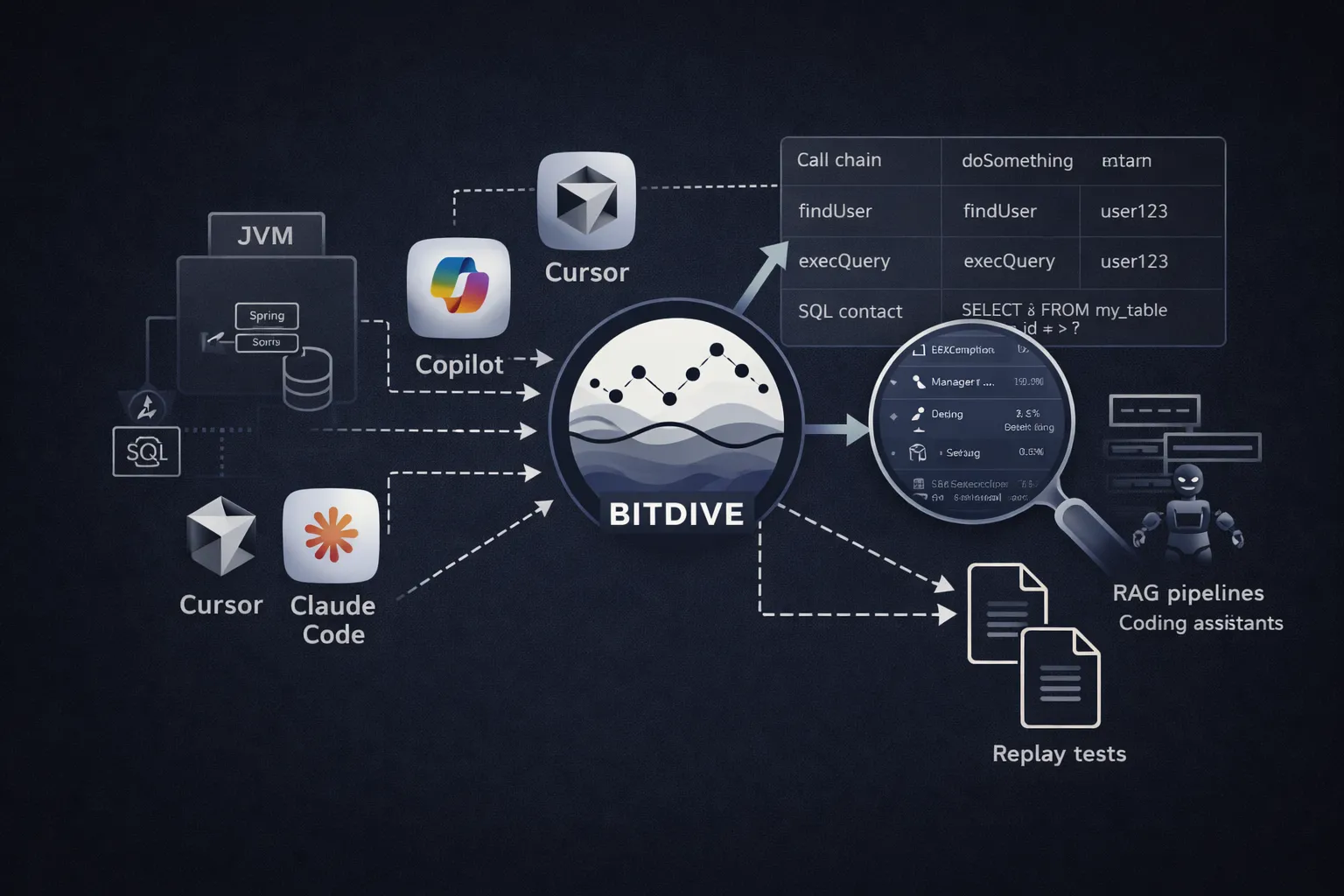
Yesterday, we announced the Model Context Protocol (MCP) Server integration for BitDive. This new capability allows you to access full runtime context for any method executed in production. including input parameters, return values, exceptions, SQL queries, and downstream calls. MCP turns observability into a daily development tool, providing Real Runtime Data directly to your AI agent.

eBPF vs. BitDive: Why AI Agents Need Runtime Context, Not Just Kernel Syscalls

· 8 min read
Evgenii Frolikov
Senior Java Architect | Expert in High-Load Systems & JVM Internals

TL;DR: eBPF is great for monitoring kernels, but it’s blind to business logic. For AI agents to effectively fix code, they need Real Runtime Data context: classes, methods, and parameters. BitDive delivers the exact Runtime Context that AI models (and humans) need to solve real application problems.


eBPF vs BitDive - Main Image

eBPF vs BitDive: Why AI Agents Need Runtime Context

Why do we need production profiling at all?

Application performance isn't abstract. It's about real issues: errors, timeouts, lost users, and wasted money. But to understand what exactly is slow, it's not enough to know that "CPU is high." You need detail: which service, which method, which request, which parameters — the kind of code-level observability that only application-level instrumentation can provide.