




Java Runtime Context for AI Agents
Before writing code, agents inspect runtime context. After changing code, they capture a new trace and compare it to the baseline to prove correctness.
See Real Data Before Writing Code
The agent fetches a full execution trace via MCP: real payloads, SQL queries, and call hierarchy. No guessing from source code alone.
Capture a New Trace and Compare
After a code change, the agent triggers the same scenario again and compares the new trace to the original. Methods, SQL, contracts, and downstream calls are checked before and after.
Preserve Verified Behavior as JUnit
Once the diff is accepted, BitDive creates or refreshes replay-based JUnit suites from the verified execution. The replay suite becomes regression memory, not the proof step itself.
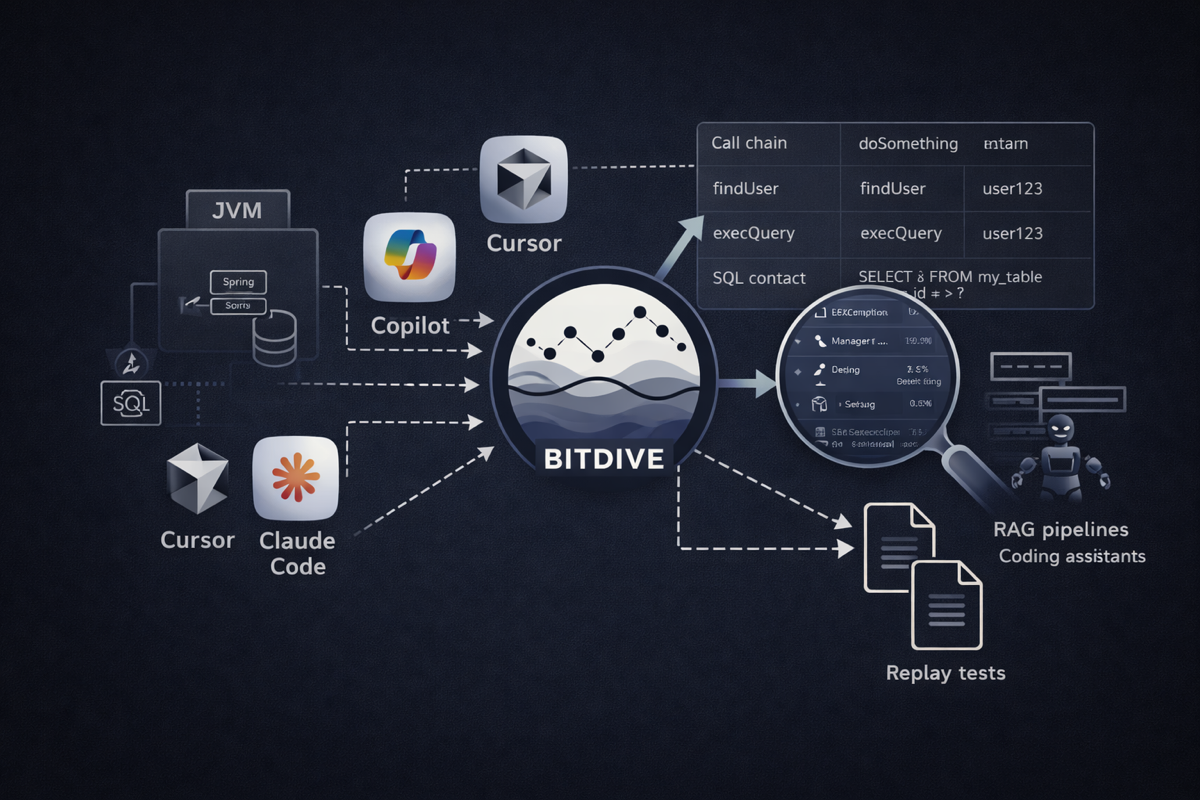
AI Agents That Verify Code Changes with Runtime Traces
AI agents that investigate, fix, and prove correctness automatically
Connect Cursor, Claude, or Windsurf to BitDive via MCP. Your agent inspects runtime context before writing code, then verifies its own changes by capturing a new trace and comparing it to the baseline.
- Runtime Context First: Before writing a fix, the agent fetches the actual execution trace: real payloads, SQL queries, call hierarchy. It understands how data really flows, not how it imagines it from source code.
- Dual-Trace Verification: After the fix, the agent captures a new trace and compares it to the original. Unchanged methods stay identical. Changed methods show exactly what shifted. The diff is the proof.
- Replay-Based Memory: Once the diff is accepted, the agent refreshes replay-based JUnit suites and runs
mvn testto confirm the wider system still holds.
From Java Runtime Traces to Verified AI Code Changes
Three stages that close the loop between real production behavior and every code change.
Capture: Real Runtime Traces
No code changes needed. Works with any Java/Kotlin service.
BitDive runs alongside your service, capturing complete execution context: every method call, every SQL query, every API response. No code changes needed.
- Method calls with exact parameters and return values
- SQL queries with actual parameters and result sets
- HTTP requests, Kafka messages, and cross-service traces
Verify: Before vs. After Trace Comparison
Capture a new trace and prove what changed
After modifying code, trigger the same scenario again, capture a new trace, and compare it to the original. See exactly what changed and confirm nothing broke unintentionally.
- Side-by-side comparison of SQL patterns and results
- Method-by-method diff of inputs and outputs
- Runtime API contract drift becomes visible immediately
Preserve: Replay-Based JUnit Regression
Turn verified behavior into reusable test memory
Once the trace diff is accepted, BitDive creates or refreshes replay-based JUnit suites from the verified execution. This locks the intended behavior into standard regression assets.
- Mocks built automatically from recorded dependency behavior
- Runs locally or in CI with zero live infrastructure dependencies
- Standard JUnit 5. Works with mvn test, IntelliJ, any CI.
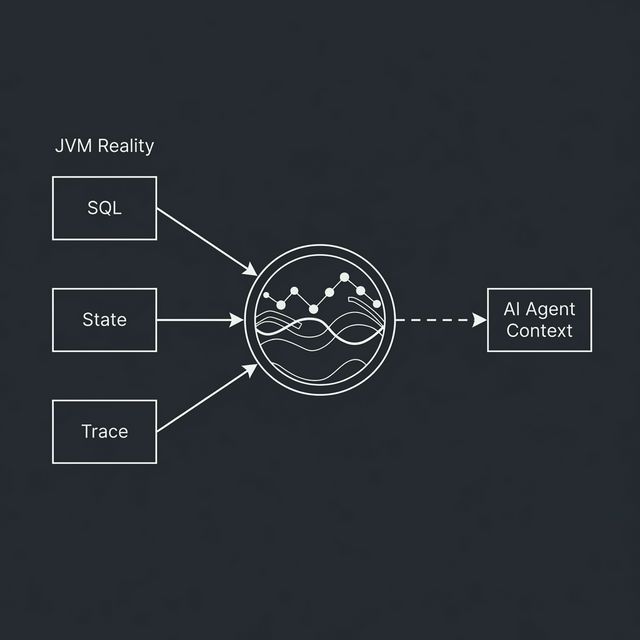
Java Runtime Context for AI Agents via MCP
Real execution facts streamed to AI agents.
Stream real payloads, SQL, call paths, and downstream responses directly into the AI's reasoning context.
- Context-Aware: AI sees parameters and return values.
- Validated Fixes: Verify changes before shipping.
- No Infrastructure: AI tests logic via replay.
AI Agent Verification Workflow with Before-and-After Trace Comparison
Secure your development lifecycle with deterministic evidence.
Discovery & Real-Knowledge
AI agents fetch real execution traces via MCP before coding. Analyze live payloads and SQL queries to eliminate hallucinations and build an accurate implementation plan.
Secure the Starting Point
Establish a behavioral baseline. Run existing replay tests (`mvn test`) to confirm current logic is stable. Then capture a baseline trace by triggering the target scenario via a real API call.
High-Precision Fixes
Implement changes with context awareness. Because the agent understands the real data flow, modifications are precise, surgical, and significantly less error-prone.
Dual-Trace Inspection
Compare the baseline and new traces. Verify that methods, SQL, contracts, and downstream operations changed exactly where intended, while external invariants remained untouched.
Universal Regression
Run a global verification cycle after the trace diff is accepted. Detect regressions in distant modules instantly. If a fix breaks an unrelated flow, the agent detects it and iterates automatically.
Replay-Based JUnit Suites
Refresh or create replay-based JUnit suites only after the change is proven. The trace diff is the proof; the replay suite preserves that proof as reusable regression memory.
Why Java Teams Add Runtime Context for AI Agents
From fragile mock scripts to tests grounded in real execution data
Refactor legacy Java systems fearlessly. Your regression safety net is built from real runtime traces.
Start creating test suites immediately. 2-minute setup, no months-long integration projects.
Give AI agents real runtime context so they stop guessing and start verifying their own code changes
Dependencies auto-mocked from captured data. Stop writing and maintaining Mockito scripts
Time to convert user flows into hundreds of runnable JUnit tests
See exact method inputs, SQL queries, and return values. No more black-box debugging
Frequently Asked Questions
Common questions about the platform.
Connect AI Agents to Java Runtime Context
Connect Cursor, Claude, or Windsurf to real Java execution traces via MCP.