Unit vs Component Tests in Spring: Where the Boundary Lies and Why You Need Both

TL;DR: In real-world Spring projects, the "unit vs integration" debate almost always stems from the fact that "integration testing" has become a catch-all term for everything from @SpringBootTest with Testcontainers to full-blown E2E runs on staging environments. To stop arguing and start shipping, we need to draw a clear line in the sand regarding responsibility.
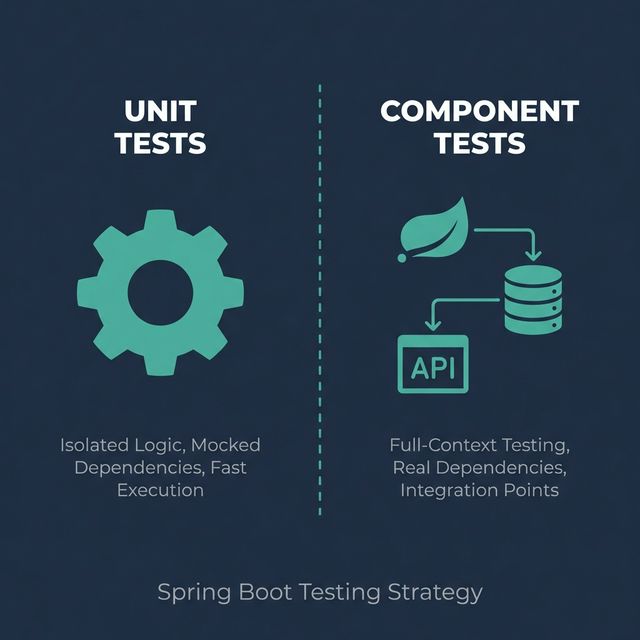
A unit test answers one question: "Is the logic correct in total isolation?" It deliberately cuts infrastructure out of the equation.
A component test answers another: "Does the component work as a system within its own boundaries, including its Spring wiring, configurations, serialization, transactions, and data access?"
If you only have units, you'll inevitably get burned at the seams. If you only have component tests, you'll pay with execution time, flakiness, and painful debugging. The winning strategy is simple: unit tests provide the speed and density of logic verification; component tests provide the confidence that the "real assembly" actually works.
What Counts as a Unit Test in the Spring World (and Why It Should Be "Spring-Free")
In a healthy engineering culture, a unit test never starts the Spring context. Once you spin up a container, you’re introducing variables that have nothing to do with your code’s logic: auto-configuration, profiles, property binding, proxies, and bean initialization order. While these are critical to test, it shouldn't happen at the unit level.
Imagine a service that applies discounts based on customer status and order composition. This code must be verifiable without Spring, without a database, and without HTTP. This allows you to blast through dozens of edge cases in milliseconds and know exactly where an error lies.
import org.junit.jupiter.api.Test;

import static org.junit.jupiter.api.Assertions.*;

class PricingServiceTest {

    @Test
    void should_apply_discount_for_vip() {
        PricingService svc = new PricingService(new DiscountPolicy());

        Money price = svc.calculatePrice(
                new Order(1000),
                new Customer(Status.VIP)
        );

        assertEquals(new Money(900), price);
    }

    @Test
    void should_not_discount_for_regular() {
        PricingService svc = new PricingService(new DiscountPolicy());

        Money price = svc.calculatePrice(
                new Order(1000),
                new Customer(Status.REGULAR)
        );

        assertEquals(new Money(1000), price);
    }
}
The goal here is checking "pure" logic, not how Spring glues it together. If this test fails, the root cause is almost always localized to a single method. This is why the unit level is your ultimate tool for development velocity and logical certainty.
If a dependency is complex, such as a repository or an external client, you substitute it. The trick isn't to "mock everything," but to mock exactly what is external to the logic you're testing.
import org.junit.jupiter.api.Test;
import static org.mockito.Mockito.*;
import static org.junit.jupiter.api.Assertions.*;

class RegistrationServiceTest {

    @Test
    void should_refuse_when_email_exists() {
        UserRepository repo = mock(UserRepository.class);
        when(repo.existsByEmail("a@b.com")).thenReturn(true);

        RegistrationService svc = new RegistrationService(repo);

        var ex = assertThrows(IllegalStateException.class,
                () -> svc.register("a@b.com"));

        assertTrue(ex.getMessage().contains("exists"));
        verify(repo).existsByEmail("a@b.com");
        verifyNoMoreInteractions(repo);
    }
}
This unit test does exactly what it’s supposed to: verify service behavior given specific responses from its dependencies.
Why Unit Tests Miss the Most Expensive Spring Application Bugs
The most painful production outages rarely happen because of a misplaced if statement. They happen at the seams:
- A DTO field was renamed, silently breaking the JSON contract.
@ConfigurationPropertiesstopped binding because of a property key change.- A transaction fails because a method is called from within the same bean, bypassing the Spring proxy.
- A repository query is valid in theory but crashes against the real production schema.
- Database migrations have drifted from the code.
- Security filters start blocking requests after a configuration update.
ObjectMapperis serializing dates in a format the frontend doesn't expect.
Unit tests aren't built to catch these. Their domain is logic in isolation. Component tests are exactly where these bugs go to die.
What Is a Component Test in Spring and Where Is Its Boundary?
A component test verifies that a component works as a system within its area of responsibility. In Spring Boot, this generally means:
- Starting a real Spring context (full or targeted).
- Calling the component through its boundary (HTTP, message handler, public service).
- Verifying the result along with its infrastructure side effects: transactions, serialization, validation, data access, and configurations.
A practical template for a REST component test is @SpringBootTest + a real HTTP client + a real database via Testcontainers. This isn't E2E across your entire microservices architecture; it’s a focused check of one service "exactly as it will live in the real world."
import org.junit.jupiter.api.Test;
import org.springframework.beans.factory.annotation.Autowired;
import org.springframework.boot.test.context.SpringBootTest;
import org.springframework.boot.test.web.client.TestRestTemplate;
import org.springframework.http.*;

import org.testcontainers.containers.PostgreSQLContainer;
import org.testcontainers.junit.jupiter.Container;
import org.testcontainers.junit.jupiter.Testcontainers;
import org.springframework.test.context.DynamicPropertyRegistry;
import org.springframework.test.context.DynamicPropertySource;

import static org.junit.jupiter.api.Assertions.*;

@SpringBootTest(webEnvironment = SpringBootTest.WebEnvironment.RANDOM_PORT)
@Testcontainers
class OrderComponentTest {

    @Container
    static PostgreSQLContainer<?> pg = new PostgreSQLContainer<>("postgres:16-alpine");

    @DynamicPropertySource
    static void props(DynamicPropertyRegistry r) {
        r.add("spring.datasource.url", pg::getJdbcUrl);
        r.add("spring.datasource.username", pg::getUsername);
        r.add("spring.datasource.password", pg::getPassword);
        r.add("spring.jpa.hibernate.ddl-auto", () -> "validate");
        // Flyway/Liquibase will also run on context startup if present.
    }

    @Autowired
    TestRestTemplate http;

    @Test
    void should_create_order_and_return_contract() {
        var req = new CreateOrderRequest("user-1", java.util.List.of("sku-1"));

        ResponseEntity<OrderResponse> resp =
                http.postForEntity("/api/orders", req, OrderResponse.class);

        assertEquals(HttpStatus.CREATED, resp.getStatusCode());
        assertNotNull(resp.getBody());
        assertNotNull(resp.getBody().id());
        assertEquals("user-1", resp.getBody().userId());
    }
}
This test simultaneously confirms that the Spring context boots, beans wire correctly, JSON contracts are intact, validation is working, and the repositories are compatible with the schema. These are the points of failure where production usually breaks, even while your unit tests stay perfectly green.
How to Keep Component Tests from Becoming "Slow Flaky Hell"
A component test becomes toxic the moment it depends on an uncontrolled environment. If your test hits a "live" staging instance of an external service, it will inevitably flake due to network lag, data shifts, rate limits, or another team's deployment schedule.
External dependencies at the component level must be either containerized or stubbed with a local contract server.
The classic Spring case: you have a client for an external REST API. A unit test with mocks is too easy to "fool": you'll model an ideal response and miss issues with headers, serialization, 4xx/5xx errors, or timeouts. A component test should exercise the real HTTP stack, but against a controlled stub server.
Here’s an example using OkHttp MockWebServer. You’re testing the real client, real serialization, and real error handling.
import okhttp3.mockwebserver.MockResponse;
import okhttp3.mockwebserver.MockWebServer;
import org.junit.jupiter.api.*;

import java.io.IOException;

import static org.junit.jupiter.api.Assertions.*;

class ExternalApiClientComponentTest {

    private MockWebServer server;

    @BeforeEach
    void start() throws IOException {
        server = new MockWebServer();
        server.start();
    }

    @AfterEach
    void stop() throws IOException {
        server.shutdown();
    }

    @Test
    void should_map_success_response() {
        server.enqueue(new MockResponse()
                .setResponseCode(200)
                .addHeader("Content-Type", "application/json")
                .setBody("{\"id\":\"42\",\"status\":\"OK\"}"));

        ExternalApiClient client = new ExternalApiClient(server.url("/").toString());

        var resp = client.getStatus("42");

        assertEquals("42", resp.id());
        assertEquals("OK", resp.status());
    }

    @Test
    void should_throw_on_500() {
        server.enqueue(new MockResponse().setResponseCode(500));

        ExternalApiClient client = new ExternalApiClient(server.url("/").toString());

        assertThrows(ExternalApiException.class, () -> client.getStatus("42"));
    }
}
This is a component test for your "integration layer." It doesn't require the full Spring context, but it tests the system on the component level: HTTP + conversion + error states. In Spring, you often do this inside @SpringBootTest, but the core remains: real protocols and seams must be verified in a controlled environment.
Where Do "Spring Slice Tests" Live Relative to Unit and Component?
@WebMvcTest, @DataJpaTest, and @JsonTest are not unit tests in the classical sense because they spin up infrastructure. They also aren't full component tests. They are "slices" that allow you to cheaply verify a specific seam.
For instance, @DataJpaTest is perfect for checking if a repository works correctly on a real database schema without booting the entire web stack.
import org.junit.jupiter.api.Test;
import org.springframework.boot.test.autoconfigure.orm.jpa.DataJpaTest;
import org.springframework.beans.factory.annotation.Autowired;

import static org.junit.jupiter.api.Assertions.*;

@DataJpaTest
class UserRepositorySliceTest {

    @Autowired
    UserRepository repo;

    @Test
    void should_find_by_email() {
        repo.save(new UserEntity(null, "a@b.com"));

        var user = repo.findByEmail("a@b.com");

        assertTrue(user.isPresent());
    }
}
This saves massive amounts of time when you need to test the JPA/SQL seam specifically, without the overhead of the entire service.
Why "Both Levels" Is Not Theory: It's Pure ROI on Regressions
If you rely solely on unit tests, your CI is fast and your logic is sound, but you pay for it with production incidents at the seams. If you rely solely on component tests, you catch those seams, but your velocity drops, tests become expensive to maintain, and debugging turns into a nightmare.
When these levels work together, they reinforce each other:
- Unit tests drastically reduce the number of potential root causes for component failures.
- Component tests guarantee that the real "glued together" application doesn't crumble due to Spring magic.
Where BitDive Fits: Reproducibility for Component Tests
The most expensive part of component testing isn’t writing @SpringBootTest. It’s reproducing real-world scenarios and maintaining stubs for dozens of integrations.
Ideally, component tests should verify what actually happens in production: real call chains, real input data, and real responses from external systems.
BitDive's approach bridges this gap: you capture execution chains (REST, SQL, Kafka, etc.), parameters, and results, then replay them in tests deterministically, substituting external interactions with the recorded dataset. This turns a component test from a "what-if" scenario into a guarantee that a real production case will never regress again.
Component Tests from Real Runtime Data
BitDive records execution chains in Spring applications and turns them into deterministic JUnit tests. No manual mocks, no hand-crafted scenarios. Tests are based on actual production behavior.
Try BitDive FreeWhat's Next?
Ready to see it in action? Check out how BitDive automates this entire cycle.
FAQ
How does a component test differ from an integration test?
A component test verifies a single service "as a system" in a controlled environment: with a real Spring context, a real database (via Testcontainers), and stubbed external services. An integration test in the broader sense often involves multiple real services running together, which is slower and less stable.
When are unit tests enough?
For "pure" business logic without infrastructure ties: calculations, validations, mappings, and complex transformations. If a method can run without Spring, a database, or HTTP, a unit test is your best friend.
Do I need @SpringBootTest for every component test?
No. Spring Slice tests (@WebMvcTest, @DataJpaTest) boot only the required context slice and are much faster than a full @SpringBootTest.
Strategy Guide Testing Spring Boot Applications with BitDive
Related Reading
- Unit Tests with BitDive – Creating deterministic JUnit tests from real traces
- Integration Tests: Replay Mode – Full Spring context with all dependencies replayed from traces
- Integration Tests: Testcontainers – Real database via Testcontainers, external APIs replayed
- BitDive vs Mockito – Why teams are moving from manual mocks to recorded behavior