Automated Verification in the AI Era: Why Trace-Based Testing is the New Standard

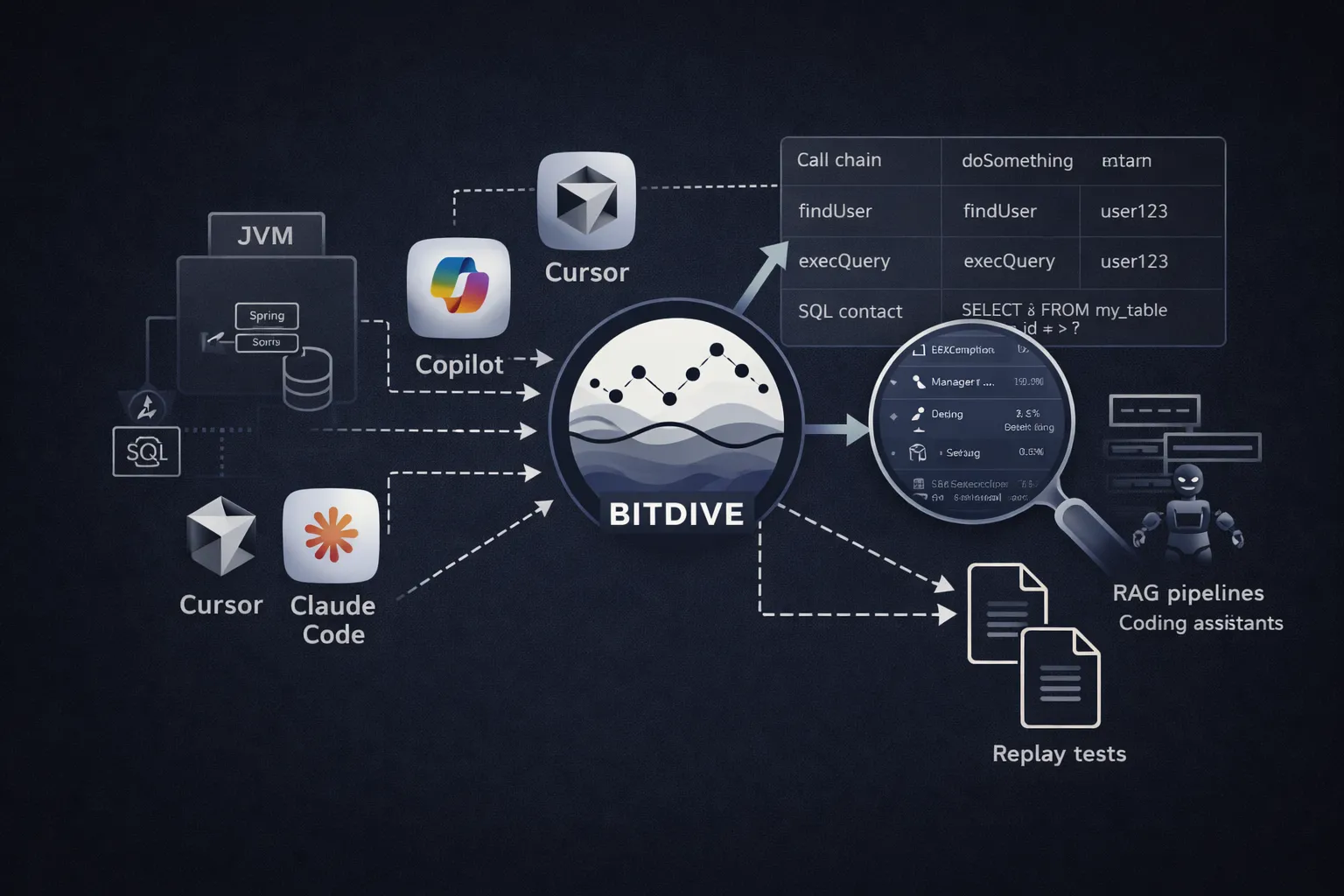
TL;DR: As AI models like Claude, GPT-4, and Gemini write more of our code, the bottleneck has shifted from writing to verifying. Traditional mock-heavy tests are too fragile for AI-native workflows. BitDive provides runtime context, before/after trace comparison, and replay-based JUnit tests that enable a safe autonomous development loop.
The Verification Gap in AI-Native Development
In 2026, the industry has reached a tipping point. AI assistants can now create 1,000 lines of functional code in seconds. However, verifying that this code doesn't break subtle production invariants remains a manual, slow process.
We call this the Verification Gap.
Why Static Analysis Isn't Enough
Linear code analysis (Linting, Sonar) only sees what the code looks like. It doesn't know how it behaves when hitting a legacy database or a complex Kafka stream. To solve this, we need Trace-Based Testing.
Read how BitDive gives AI agents real runtime context
If an AI can create a 2,000-line Pull Request in minutes, how can a human (or even another AI) ensure that this code hasn't broken anything? And how do we avoid drowning in the maintenance of thousands of tests that break with every refactoring?
The "Code Explosion" Problem: Why Traditional Tests No Longer Work
According to the Greptile 2025 report, the amount of code produced per developer has increased by 76%. At the same time, the complexity and fragility of tests have become the primary bottleneck for teams.
The traditional approach to writing tests faces three "productivity killers":
- Mocking Hell: Writing and maintaining mocks for complex systems takes more time than writing the business logic itself.
- Review Fatigue: Developers stop carefully checking AI-generated tests, missing subtle logical errors.
- Knowledge Gap: When AI writes the tests, the team stops understanding exactly what they are verifying.
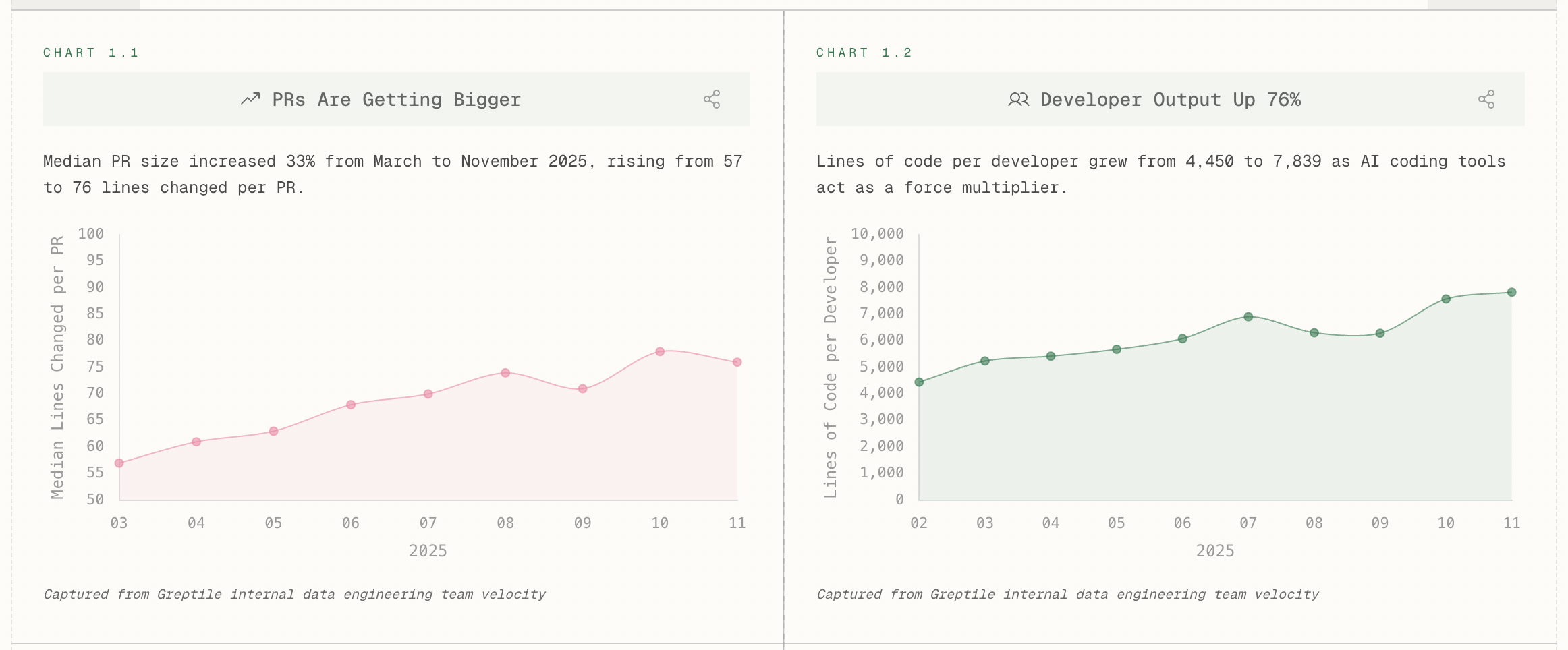 Fig 1. The explosive growth of code volume makes manual verification impossible (Data source: Greptile 2025).
Meet BitDive: Trace-Based Testing
BitDive is a platform that changes the game. Instead of forcing you to write tests manually or rely on AI guesses, BitDive captures real system behavior, lets teams compare new traces to the baseline, and turns verified executions into deterministic JUnit 5 tests.
Pillar 1: Testing from Real Traces
BitDive uses a lightweight Java agent that attaches to your application and records call chains, method parameters, SQL queries, and downstream API responses. Learn more about the architecture in our official introduction.
How it works:
- You run the application in a Dev or Staging environment.
- BitDive records real-world usage scenarios (traces).
- The system builds a JSON Replay Plan from the captured data.
- You run this plan as a standard JUnit 5 test in your CI/CD (Maven/Gradle). Setup is described in our guide.
The Result: You get business-accurate regression coverage based on real traces, not invented fixtures.
Critical Distinction: Recorded vs. AI-Generated
It is important to clarify that BitDive is NOT an AI test generator (like Diffblue or Copilot).
- AI Test Generators are probabilistic. They analyze source code and "guess" what the test should look like. These tests often fail, require debugging, or assert incorrect behavior (hallucinations).
- BitDive is deterministic. It records what actually happened in your running application. The tests work on the first run because they replay real traces, real SQL results, and real API responses. There is nothing to debug.
Pillar 2: The Autonomous Quality Loop
In the AI era, simply having tests isn't enough. We need a workflow that allows AI agents to verify their own work. BitDive enables the Autonomous Quality Loop, a 6-step workflow for safe AI coding:
- RUNTIME CONTEXT: The agent fetches a real execution trace via MCP to understand how the code actually runs.
- BASELINE: The agent runs
mvn testto confirm the current code is stable. - IMPLEMENTATION: The agent modifies the code based on runtime context and the baseline trace (e.g., fixing an N+1 query).
- DUAL-TRACE INSPECTION: The agent captures a new trace and compares it "before vs. after" to verify the fix.
- GLOBAL REGRESSION: The agent runs the full suite to ensure no regressions were introduced.
- REPORT: The agent commits the change with trace diffs as proof of correctness.
This transforms the AI from a "code generator" into a true "engineering agent" responsible for the final result.
Runtime Observability Without Logs
When a test fails, BitDive doesn't just say "Expected 200, got 500". You get a full visual dump of the execution:
- HeatMap: See which methods were actually executed.
- Service Map: How requests flowed between microservices.
- Distributed Tracing: A detailed timeline via code-level observability of every SQL query and HTTP call.
Fig 3. Execution visualization allows you to find errors in seconds without reading gigabytes of logs. Details in the HeatMap description.
Why BitDive is the Enterprise Choice
- Instant Instrumentation: No changes to your application code required. Just add the dependency, and the agent does the rest.
- Security (PII Masking): BitDive automatically masks sensitive data (emails, credit cards) before traces are saved.
- Performance: Agent overhead is minimal (0.5–5% CPU), making it suitable for high-load systems.
- Auto-Mocking: Forget about setting up complex databases for every test. BitDive replays SQL results directly from the recording, running entirely in memory.
Conclusion
The main challenge of 2026 is learning to validate code faster than AI can create it. BitDive provides teams with a verification layer grounded in runtime traces, before/after comparison, and replay-based regression memory, turning fragile manual testing into a distinct, reliable engineering discipline.
Ready to close the Verification Gap?
Explore how Trace-Based Testing can transform your strategy.
View Market Landscape | View Pricing | Explore the Documentation | Browse the Glossary
Published by the BitDive Team. Deterministic testing for the modern Java stack.