Test to Code Ratio: Why 50%+ Test Code is the New Standard in 2026

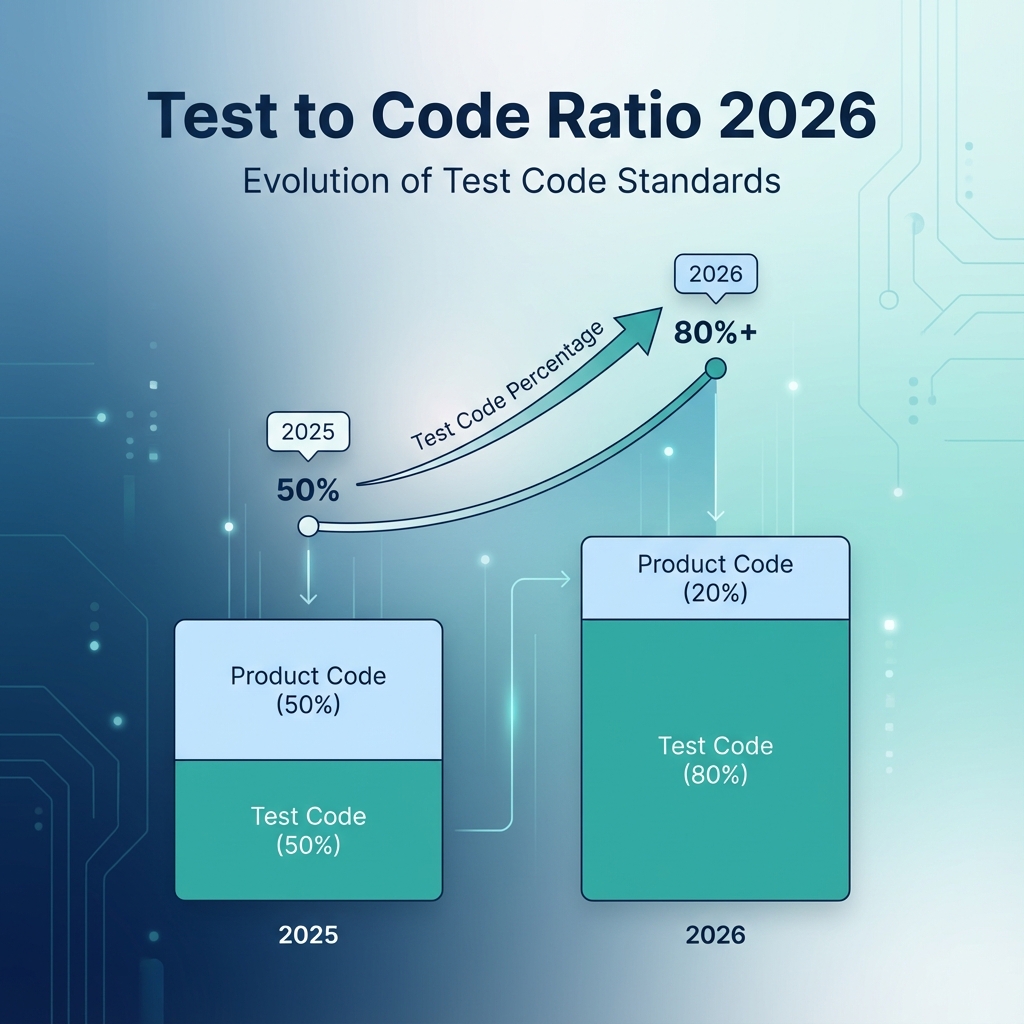
In the era of AI-accelerated delivery, the old 1:1 test-to-code ratio is a relic. To survive 2026, teams need 50%+ test density to handle the explosion of generated features. BitDive enables this density without the 3x maintenance cost, turning runtime behavior into a strategic Trace-Based quality moat.
What Recent Research Shows
- The Law of "Co-Evolution": A study by Miranda et al. (2025), analyzing over 500 repositories, showed that test code and product code grow synchronously. Tests are not an add-on, but an integrated part of the product.
- The Maturity Paradox (Covrig 2, ICST 2025): In the most mature and reliable projects, a clear trend is observed: the growth of test lines of code (TLOC) systematically exceeds the growth of executable product code (ELOC). This means that over time, the ratio steadily shifts towards tests.
To add 100 lines of new business logic to a stable project, engineers have to write 120–150 lines of tests to guarantee the absence of regressions. Tests accumulate faster than new functionality.
2026 Standard Ratios by Project Type
If we consider the entire codebase as 100% (Product Code + Test Code), a healthy distribution in 2026 looks like this:
| Project Type | Test Code Share | Ratio (Prod:Test) | Main Driver |
|---|---|---|---|
| Healthy Project | 50% | 1:1 | General minimum standard |
| Mature Backend | 50%-55% | 1:1.1. 1:1.2 | Regression test accumulation (Covrig 2 data) |
| High Reliability | 65%-75% | 1:2. 1:3 | Financial sector, TDD, boundary condition coverage |
Key takeaways:
- The old 1:1 ratio is now the minimum baseline for healthy projects
- Mature backend systems naturally accumulate more tests over time
- High-reliability domains (finance, healthcare, critical infrastructure) require significantly more test code
- This isn't technical debt, it's quality investment
Why Are There So Many Tests?
It would seem that checking a sum(a, b) function is one line. Why does the code grow?
- Use Cases: One function needs 5-10 tests (positive scenario, negative, boundary values, null values, large numbers, etc.).
- Data Preparation (Fixtures/Mocks): To test complex business logic, you need to "fake" the database, API response, create user objects. This setup code often takes up more space than the check (Assert) itself.
- Readability: Test code is intentionally written to be more "verbose" and explicit, without complex abstraction, so that when a test fails, it is immediately clear what happened.
Stop Maintaining Test Code, Start Preventing Bugs
BitDive eliminates test maintenance burden with automated test creation. Capture real traffic, auto-mock dependencies, and detect regressions automatically, no test scripts to write or maintain.
Try BitDive TodayDependence on the Testing Pyramid Level
The ratio strongly depends on what exactly tests you write.
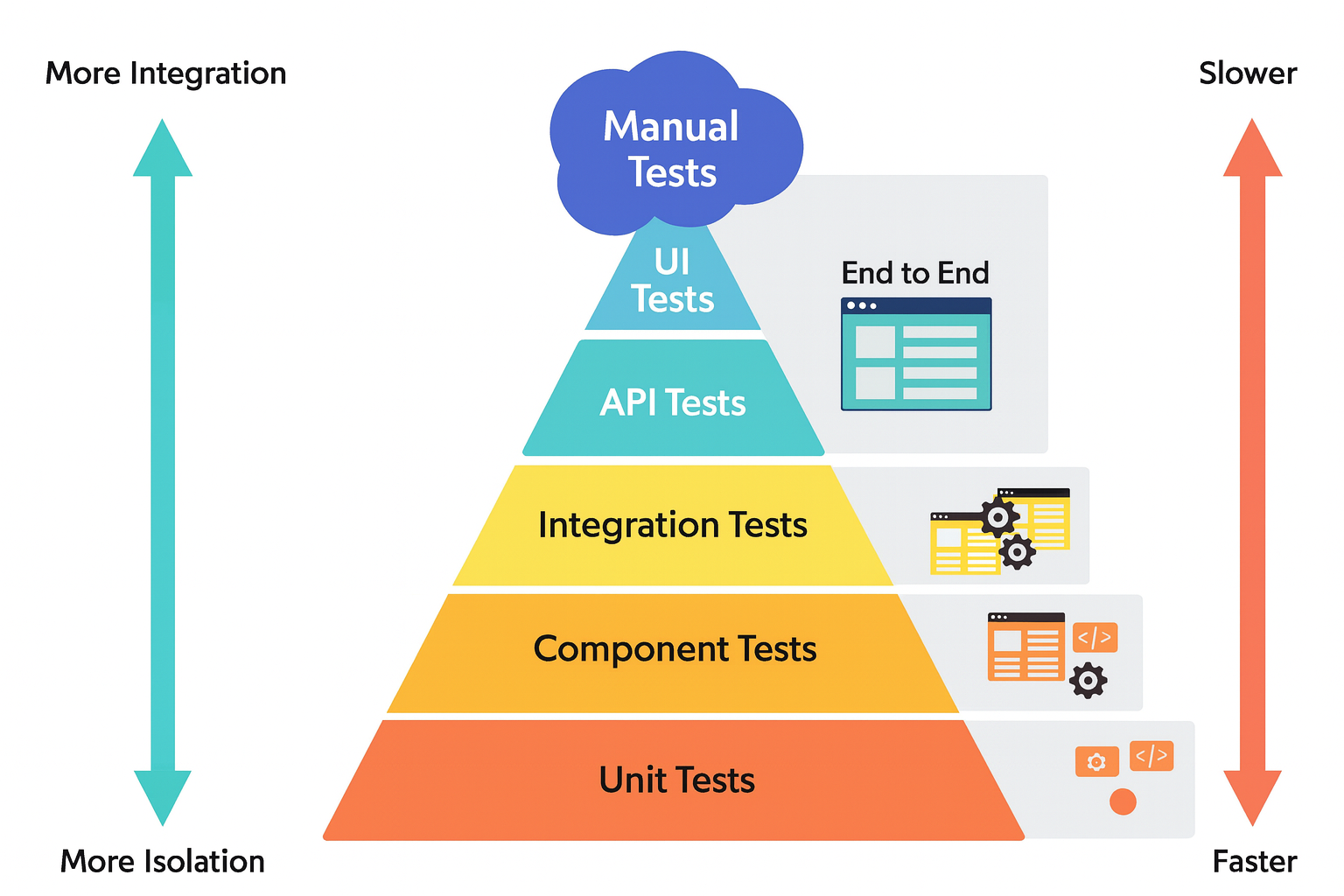
- Unit Tests: The most voluminous in terms of lines of code. They require mocks (simulating dependencies) and check every branch of logic (
if/else). They are what inflate statistics to 1:2. - Integration: Less code, but more complex configuration.
- E2E (End-to-End): Usually take up the least amount of code (scenarios like "open page -> click button"), but take the longest to execute.
New Drivers in 2026: AI and Test Code Growth
Two key factors in recent years exacerbate the growth of test code:
- LLM as a "Test Factory": Lowering the cost of writing tests through AI creation (e.g., 17,000 lines of tests in an hour) means teams can afford higher ratios (e.g., 1:3) without sacrificing budget. The volume of test code grows exponentially, but its cost falls.
- Shift-Left and DevOps: Implementing TDD and strict Quality Gates in CI/CD (e.g., requiring 70% coverage for merge) makes having a large volume of Unit tests mandatory.
How to Measure Test Code Ratio on Your Project
If you want to measure this yourself or evaluate someone else's project, it is best to use the cloc (Count Lines of Code) utility. It ignores whitespace and comments, giving clean statistics.
Example terminal command:
cloc . --exclude-dir=node_modules,build,dist
How to calculate the Ratio:
Ratio = Test Code Lines / Product Code Lines
Example: With 10,000 lines of source code and 15,000 lines of tests, the ratio is 1.5 (1:1.5), meaning tests represent 60% of the total codebase (15,000 / 25,000).
BitDive: Solving the "Test Code Co-Evolution" Problem
The BitDive platform offers a radical solution to the problem of constantly growing and maintenance-heavy test code, implementing the Trace-Based Automation concept:
Instead of manually writing E2E scripts, maintaining mountains of test code and fragile mocks, BitDive uses a Capture & Replay approach:
- Trace-Based Automation: Coverage grows with real product usage, not with the number of written test classes.
- Automatic Mocks and Environments: BitDive automatically virtualizes external dependencies (DB, API, queues) based on recorded traces, making tests deterministic and fast.
- Protection against Unexpected Behavior: BitDive compares not only status but also response structure, SQL patterns, and call sequences. This catches Unexpected Behavior Changes that ordinary tests miss, providing deep observability into every test run.
BitDive synchronizes tests with code automatically, freeing engineers from manual maintenance of a growing volume of test codebase, which, according to new 2025 standards, must exceed 50%.
What This Means Strategically
In the classic model, you buy stability with lines of test code and engineering time. The safer you want to feel, the more you invest into writing and maintaining tests.
BitDive changes the unit of work: you do not encode behavior in test code, you record real executions and reuse them as replayable checks. The source of truth becomes Real Runtime Data, not assertions in a test file.
This gives three practical effects:
- Test coverage grows with real traffic, not with the size of the QA team.
- You validate end-to-end behavior of services, data, and dependencies, not just isolated methods.
- QA and developers spend less time on scaffolding and more on decisions about what to protect and what to fix.
This model is easier to trust. Any change, no matter who wrote it, must pass the same captured and replayed scenarios.
The AI Moat: High-Density Testing for High-Speed Refactoring
When AI (like Cursor or Windsurf) writes 76% more code, your humans cannot review it all. You need a Regression Safety Net.
BitDive creates this safety net by:
- Recording everything: Capturing the baseline behavior of your critical services.
- Enabling Bold Refactoring: When the AI proposes a major architectural shift, BitDive ensures that the Business Intent remains preserved via thousands of replayed runtime scenarios.
- Reducing Maintenance: Instead of writing thousands of lines of code to achieve a 1:3 ratio, you let BitDive manage the validation at the runtime level.
This is how modern teams maintain a 1:3 ratio without hiring a massive QA department.
Ready to Escape Test Maintenance Hell?
Join engineering teams who've eliminated 80% of test maintenance work with BitDive's trace-based approach. Capture real traffic, verify behavior automatically, and focus on building features instead of maintaining test scripts.
Start Free TrialReferences
- Miranda, C., Avelino, G., Santos Neto, P. Test Co-Evolution in Software Projects: A Large-Scale Empirical Study. Journal of Software: Evolution and Process, 2025.
- Miranda, C. et al. Highlight Test Code: Visualizing the Co-Evolution of Test and Production Code. SBES Tools 2025.
- Covrig 2 (ICST 2025). Code, Test, and Coverage Evolution in Mature Software Systems: Changes over the Past Decade. International Conference on Software Testing, Verification and Validation, 2025.
- Chi, J. et al. Automated Co-evolution of Production and Test Code Based on Dynamic Validation and Large Language Models (REACCEPT). arXiv 2411.11033, 2024.
- Early (Startearly.ai). Creating 17 000 lines of working test code in less than an hour. Blog, July 2024.
- Kebaili, Z. K. et al. Automated testing of metamodels and code co-evolution. Software and Systems Modeling, 2024.
- Imran et al. Is code coverage of performance tests related to source code features and test suite design. Empirical Software Engineering, 2025.