Why AI Coding Agents Break APIs (And How BitDive Restores Their Vision via MCP)

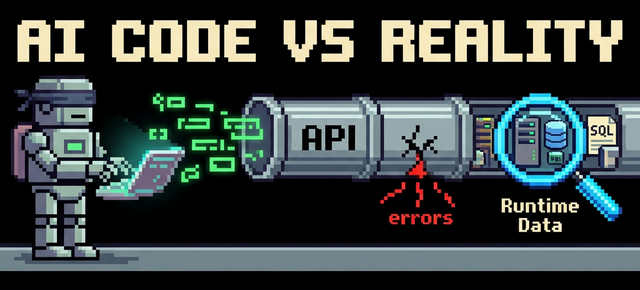
TL;DR: AI coding agents are incredibly powerful at reading and writing source code, but when it comes to understanding what code actually does at runtime, they are blind. They can read `repository.findAll()` in the source code, but they cannot see the 40-query N+1 explosion it causes in production. This post explores how AI routinely breaks APIs and how connecting agents to real runtime data using BitDive and the Model Context Protocol (MCP) dramatically improves their reliability.
The AI Runtime Blindness Problem
Modern AI coding agents (like Cursor, GitHub Copilot, and Cline) have revolutionized developer velocity. They have near-perfect recall of syntax, framework paradigms, and project structure.
However, they suffer from a fundamental limitation: Runtime Blindness.
A static code file does not tell the whole story. Spring Boot auto-configurations, Jackson serialization rules, database connection pool exhaustion, and intermittent network timeouts are all invisible to a Language Model that is simply reading a `.java` file. Consequently, when an AI refactors code, it makes assumptions about the runtime state that are often perilously wrong.
5 Ways AI Agents Silently Break APIs
1. The N+1 Query Explosion
You ask the AI to "add the student's enrolled courses to the response payload." The AI happily loops over a list of students and calls `courseRepo.findByStudentId(id)` for each one. The code is syntactically perfect. The unit tests pass. Yet, in production, an endpoint that used to fire one query now fires 51, bringing the database to a crawl. The AI could not foresee the performance degradation because it lacks visibility into the database execution layer.
2. Accidental JSON Serialization Shifts
You ask the AI to refactor an old messy DTO into a clean Java Record. The AI does a fantastic job with the boilerplate. But you didn't notice that the AI forgot to carry over a `@JsonFormat(pattern = "yyyy-MM-dd")` annotation, or that a boolean getter was renamed from `isEligible()` to `getEligible()`. The Java code compiles, but upstream services trying to parse your JSON response suddenly crash. Your API contract has silently shifted.
3. Swallowed Exceptions
When instructed to "handle errors from the external integration," an AI will frequently wrap a Feign Client call in a `try/catch` block that simply prints a stack trace and returns a default `null` object. The application no longer crashes (which satisfies the AI's immediate goal), but the business logic downstream now operates on null or corrupted data.
4. Erasing Vital HTTP Headers
During a major code cleanup, an AI might streamline your REST template configuration. In doing so, it drops the implicit propagation of an `X-Correlation-ID` or a custom `Authorization` token that wasn't explicitly mentioned in the file it was focusing on. The downstream service starts returning `401 Unauthorized`.
5. Sequential Execution Bottlenecks
When an AI writes logic to fetch data from three different microscopic services, it defaults to sequential loops: fetch A, wait, fetch B, wait, fetch C. Without runtime context, the AI has no idea that service C takes 800ms to respond, destroying your application's 200ms SLA.
Giving AI its Vision Back: The BitDive Solution
The only way to stop AI from breaking runtime contracts is to feed it real runtime data. This is exactly what the BitDive MCP Server is built for.
By connecting an AI agent to the BitDive APM and tracing platform via the Model Context Protocol (MCP) standard, the agent can investigate the consequences of its own code.
The "Understand Before Changing" Workflow
Before the AI touches the code, it uses its tools to fetch a trace of the target method: ``` Agent -> get_last_calls -> find_trace_summary ``` Instead of just reading `repository.findAll()`, the AI now reads the actual SQL queries executed, the REST calls made, and the exact JSON returned. It understands what the code DOES, not just what it SAYS.
The "Verify After Changing" Workflow
After modifying the code, the developer triggers the endpoint, and the AI runs a comparison: ``` Agent -> compare_traces(before_call_id, after_call_id) ``` The MCP server returns a calculated diff:
- New SQL queries: 45 (Alert: N+1 detected)
- Response payload: Field `eligible` renamed to `isEligible`
- Performance: +850ms latency
The AI immediately sees its own mistake and fixes the N+1 query and JSON serialization before creating a Pull Request.
Token-Efficient Runtime Summaries
The challenge with feeding traces to Large Language Models is the context window. A raw production trace can easily exceed 2.5MB of JSON.
The magic of the BitDive MCP Server is server-side summarization. An intelligent middleware strips out the time-series arrays, internal rule evaluation data, and purely administrative fields. It condenses megabytes of JSON into a 1.5KB summary that highlights only what the AI needs for decision-making: call counts, average times, HTTP 4xx/5xx breakdowns, and exact SQL payloads.
Empower Your AI Agents with BitDive
BitDive's MCP Server connects Cursor, Copilot, and Cline to live application traces. Give your AI agents the real runtime data they need to self-verify code changes, prevent N+1 queries, and utilize trace-based testing.
Read the MCP Integration GuideConclusion
AI coding agents are brilliant typists, but they need an architect to guide them. By integrating APM and observability data directly into their decision loop via MCP, we upgrade them from blind code-generators to context-aware engineers capable of deterministic verification.